
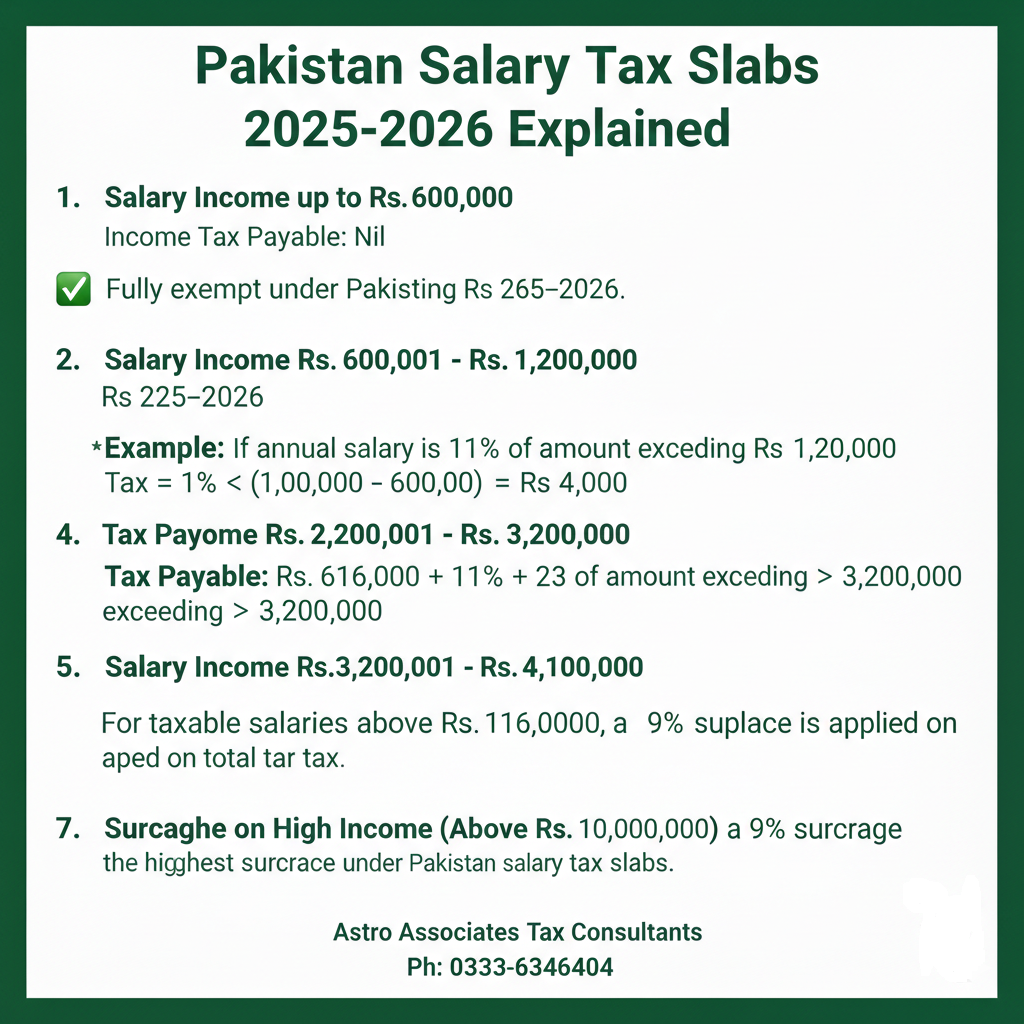

Navigating the complexities of income tax can be challenging, but understanding the income tax slab rates is crucial for every salaried individual in Pakistan. The Finance Act for the fiscal year 2025–2026 has outlined specific tiers for taxable income, each with its own tax rate and fixed tax component. This guide aims to clarify these slabs, helping you understand your tax obligations.
The progressive tax system in Pakistan means that as your income increases, so does the percentage of tax you are liable to pay. This approach ensures that individuals with higher earning capacities contribute proportionally more to the national exchequer.
Here's a detailed breakdown of the Pakistan Income Tax Slab Rates for the salaried class for 2025–2026:
Pakistan Income Tax Slab Rates (Salaried Class) FY 2025–2026
| Taxable Annual Income (PKR) | Income Tax Payable |
| Up to Rs. 600,000 | Nil (0%) |
| Rs. 600,001 – 1,200,000 | 1% of the amount exceeding Rs. 600,000 |
| Rs. 1,200,001 – 2,200,000 | Rs. 6,000 + 11% of the amount exceeding Rs. 1,200,000 |
| Rs. 2,200,001 – 3,200,000 | Rs. 116,000 + 23% of the amount exceeding Rs. 2,200,000 |
| Rs. 3,200,001 – 4,100,000 | Rs. 346,000 + 30% of the amount exceeding Rs. 3,200,000 |
| Above Rs. 4,100,000 | Rs. 616,000 + 35% of the amount exceeding Rs. 4,100,000 |
Key Points to Remember:
-
Exemption Limit: The most significant relief comes for those earning up to Rs. 600,000 annually, who are fully exempt from income tax. This aims to protect lower-income groups from the tax burden.
-
Progressive Taxation: Beyond the exemption limit, the tax rate gradually increases with each slab. For instance, an individual earning Rs. 1,000,000 (falling in the second slab) would pay 1% on the amount exceeding Rs. 600,000. So, (1,000,000 - 600,000) * 1% = Rs. 4,000.
-
Fixed Tax Component: From the third slab onwards, a fixed tax amount is added, along with a percentage on the amount exceeding the lower limit of that specific slab. This structure ensures a smoother transition between tax brackets.
-
Surcharge on High Income: A critical detail for high-income earners is the surcharge. For taxable salaries exceeding Rs. 10,000,000 per annum, an additional 9% surcharge is applied to the total income tax payable. This measure aims to increase the contribution from the wealthiest segments of society.
Understanding these income tax slab rates is not just about compliance; it's about effective financial planning. By knowing which bracket your income falls into, you can better estimate your net income and plan your expenditures and savings accordingly.
For precise calculations and personalized tax advice, especially if your income falls into the higher brackets or involves other sources of income, it is always recommended to consult with a professional tax consultant.